
Ghost of Yōtei: Was it Worth the Wait?

Updated: Jul 7

Released in 2025, Sucker Punch Productions has been hard at work developing the standalone sequel, Ghost of Yōtei, following the 2020 game, Ghost of Tsushima.
Sucker Punch have accomplished a great feat of releasing another game within the same universe that feels complementary but still divergent. Whilst the over-arching plot of Ghost of Tsushima was rooted in the embellished re-tellings of the Mongol invasions of Japan in 1274 and 1281, on a far smaller scale the plot of Ghost of Yōtei centers on a personal story of loss and vengeance.

Our protagonist, Atsu, is the daughter of Kengo and Yone, her father being a skilled swordsmith, brought up by simple means on a modest homestead in Ezo. In Ghost of Yōtei, our protagonist lives on the opposite side of the societal scale than in Ghost of Tsushima. We experience, actively in the world as well as central to Atsu's life; famine, crime, bounty hunting, gambling and other acts of desperation. Unlike the privilege and polish of the samurai, our protagonist comes from no honourable lineage, clan and has no birthright. It is refreshing to see the same world that Sucker Punch has crafted but through a vastly different lens.

Inner conflict is critical in both engaging storytelling and character progression. Sucker Punch again delivers a hard-hitting narrative about a protagonist who is deeply flawed, struggling against the push and pull of conflict; both internal and external, trying their best to do the right thing amidst the chaos. In my opinion, Atsu's story of loss and grief hit a stronger chord with me in a different way that Jin's internal and external struggles did. The cyclical nature of revenge is by no means a new theme in popular culture, however, Sucker Punch does not celebrate violence or romanticise the protagonist's use of it. One thing that Sucker Punch masterfully juggles is the presence and power of moral grey areas, both in the protagonist and antagonist. Their bias isn't shoveled down your throat, leaving you, the player to contemplate these centerpiece moments and decide for yourself.

In Ghost of Yōtei, you can still engage in familiar activities like the Inari Shrines, Bamboo Srikes, Hot Springs, Altars of Reflection, Pillars of the Fallen, and Mountain Reliquaries. Sucker Punch cranks it up a gear with fun downtime activities such as: the sumi-e painting, metalworking at the smith, playing the shamisen, cooking food at your camp, solvng puzzle boxes, playing a game or two of zenji hajiki, visiting wolf dens and liberating Yotei Six camps. There is a plethora of pasttimes and engagements to occupy your time and distract you from the central plot if need be. In my opinion, I believe it is better for the player's experience to have that access, even if it doesn't quite tickle their fancy.

Atsu's weapon arsenal gets a big kick into fifth gear. You now have nine weapons at your disposal; with her Katana, the dual Katana, the Yari spear, the Kusarigama, the giant Odachi, the Hankyu shortbow, the Yumi longbow, the matchlock Tanegashima and the concealable Tanzutsu pistol. That's not even including throwables, consumables and explosives. It's a complex game of rock-paper-scissors, the swift demand of switching your weapon to counter the appropriate enemy type. It can get dizzying at first, but after some ingrained learning, you become a master of timing and button layout. The learning curve in this game feels steep at first but is extremely satisfying once you become confident.

Ghost of Yōtei definitely addresses a good portion of complaints and issues felt in Ghost of Tsushima. The historical accuracy of the weapons and armour used by samurai in the 13th century is often called into question when talking about the Sengoku period and how well Ghost of Tsushima adheres to the period. Ghost of Yōtei feels more grounded in realism, with the katana becoming a more predominant weapon used by samurai during the later Edo period. The stances in Ghost of Tsushima, albeit fun and visually striking, are such a farcry from traditional kamae (stances), the closest one perhaps being the Stone Stance, so I was glad to see them switch things up. Having a gear loadout system was a complete game changer too. I was thrilled with the 1.1 update.

One thing I really do applaud Sucker Punch for, is the extent of freedom that you have in this game as a player. There is no rail-roading and the game diverges from the more linear storytelling found in Ghost lf Tsushima. You may not be able to do whatever you want to whenever you wish, but you can actively make decisions to gather intel and track down specific members of The Yōtei Six over others. Obviously, you can't just head straight to Shimura's castle and end the game there, but the open-ended framework of the central plot is felt and it is freeing.
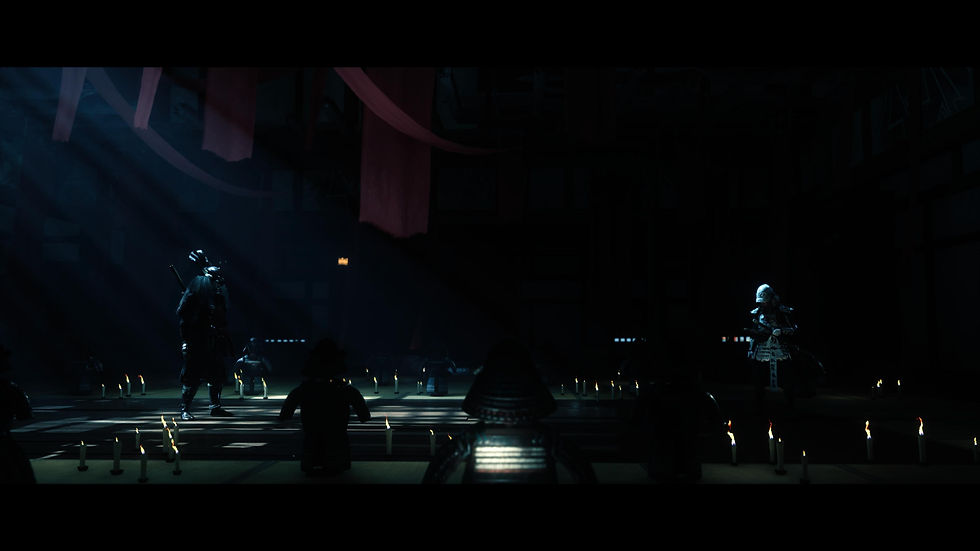
My one gripe with Ghost of Yotei however, is that I felt less of a sentimental connection with the secondary characters. In Ghost of Tsushima, Jin's heart-warming and oftentimes tense relationship with his uncle, Shimura, is so reflective of the overall tone and theme within the game. His subtle romance with Yuna, the tragedy of Norio and his brothers, the fate of young Taka, and the passing of Yuriko in front of your very eyes is heart-breaking, Additionally and perhaps most importantly, the lengths that Ryuzo and Jin, once considered brothers, have now diverged, drastically. The things they are forced to do and the people they have to become is one of the most hard-hitting moments in the game. The relationships in Ghost of Tsushima are indicative of the demands and struggles on the time. The breadth and intensity of Jin's relationships in Ghost of Tsushima shakes the player to their core. With Ghost of Yotei, I found myself trying to care about these one-note characters that are getting pulled into Atsu's story but they ended up falling into the background like wallflowers.

Given the open-world structure and similar revenge driven plot, Ghost of Yotei can feel iterative and it isn't a huge departure from the original material. Is it a game worthy of its praise? Yes. Is it a phenomenal game to be showcased on the PS5? Absolutely. Is it at the forefront of rich storytelling in games? Perhaps not. But, Sucker Punch delivers yet again with the polish and pristineness in the visuals, visceral combat with innovative changes, and of course, their ability to convey emotion through sound, scores, and the absence of noise. 8.5/10

By Lucas Barker, a casual gamer with a passion for games with visceral combat, thrilling gameplay, aesthetic environments, well-developed characters, and complex story plots. 2/9/25


Comments